Essay Music Discovery Economics
TikTok Views to Spotify Streams Conversion Rates
Most views never become streams, and the leaks are fixable.
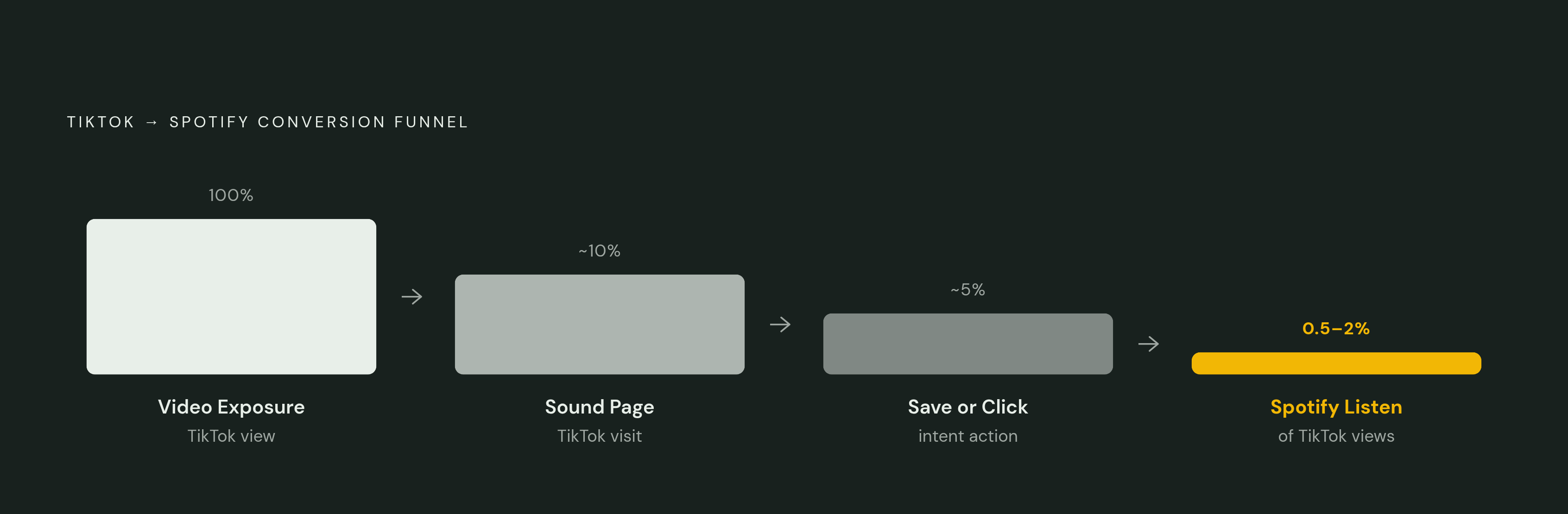
TikTok views convert to Spotify streams at an average rate of 0.5–2%, a benchmark for the discovery-to-listen funnel. Conversion depends on how effectively an artist connects discovery, the Sound Page, a save or click, and an actual listen.
What the TikTok-to-Spotify funnel actually is and why view count is the wrong number to track
Artists often expect views to turn into streams on their own. Yet a TikTok viewer is choosing entertainment in a feed, while a Spotify listener has made an active choice to hear a song again. Those are different kinds of attention. The funnel has to bridge them through four stages, moving from video exposure to the Sound Page, then toward a save or destination click, and finally to listening. The overall conversion rate shows how many people drop off along that path, which involves more than one decision.
Views show how many people start the funnel, but they cannot show how willing those people are to leave TikTok for music. Likes, comments, shares, and sound uses describe other forms of engagement, but none reliably establishes Spotify listener intent. A creator can reuse a sound because it serves a video concept without wanting to hear the full track. Add to Music saves offer a stronger signal. Even then, saving a song and playing it are separate actions, so a healthy discovery number cannot establish that the rest of the funnel works.
How the Add to Music App button is the funnel's structural hinge
TikTok’s Add to Music App button connects discovery to a listener’s streaming library. That makes it the central mid-funnel mechanism, because interest can become a save without depending entirely on the viewer remembering the song later. For Spotify, however, a save still needs to become a listen, while alternative routes through a profile or smart link introduce their own handoffs.
TikTok and Apple Music launched Play Full Song in March 2026, so Apple Music subscribers can hear full-length tracks inside TikTok. Spotify does not have the same in-app full-song playback. A Spotify campaign still depends on a save, a profile click, a smart link, or later recall to move someone toward playback.
Reels content can surface in the algorithm for up to 75 days, compared with TikTok’s roughly 35-day peak window, giving a strong Reel longer to accumulate views. Distribution lifespan and conversion friction are different variables. TikTok’s save mechanism helps explain its role in a music campaign, but it does not justify treating reach on another platform as interchangeable with a completed Spotify handoff.
Why most funnels leak: the three failure modes that kill conversion before a stream happens
Poor conversion usually points to a technical, content, or audience failure. Technical faults are the most direct to diagnose. A wrong artist name, incorrect track title, or missing artwork weakens trust, while linking errors can send a save to the wrong track or nowhere at all. Artists should check their Sound Page soon after release and try the Add to Music App flow themselves. Otherwise, a broken route can look like weak demand.
If a viral excerpt sounds dramatically different from the full recording, listeners can abandon it quickly. The same problem arises when the familiar hook arrives deep in the track. Artists with that mismatch should consider a TikTok version that puts the hook near the start, because high views and poor Spotify completion can slow the song’s growth on streaming services. A successful video concept can also conceal weak interest in the music itself.
Audience failures require a different response. Views from people with little interest in the genre convert poorly even when every link works, and regions where Spotify is not the dominant service will produce a different Spotify conversion rate. Content format and hashtags influence that audience fit. For the organic handoff, a smart link from Linkfire or Feature.fm can route listeners to their preferred service instead of sending Apple Music users to a Spotify-only destination. The landing page should focus on one song with a play button and a save button to avoid choices that interrupt the decision.
What the data says about viral moments specifically — and why going viral is not the same as building streaming traction
Most genuinely viral songs do not turn that moment into lasting Spotify growth. What remains uncertain is whether the audience wants the recording beyond the clip, and whether that interest survives the move to a streaming service.
The efficiency of viral moments has also declined sharply year over year. Virality now develops faster and is more common, with attention that once took nearly a year to accumulate arriving within weeks. At the same time, more songs compete for listeners after those moments.
TikTok is nearly table stakes for chart success, but that does not make TikTok virality a reliable route to it. Presence and sufficiency are different claims. The strategic response is to build a working conversion path and sustain it across multiple posts.
Views show how many people start the funnel, but they cannot show how willing those people are to leave TikTok for music.
The content levers that actually move conversion rate — what an artist posts determines more than how many people see it
For artists acting on that distinction, content type is the largest controllable lever. Lyric storytime and song-meaning explainers outperform dance choreography for conversion because they invite attention to the song itself. Conversion is lowest when creators use a song as generic background music. In that format, the viewer’s attachment is primarily to the creator or concept, leaving the track incidental to the experience.
Lyric videos, beat cuts, and brat-style text formats keep the focus on the recording so the idea around it does not take over. They are better suited to generating saves and Sound Page visits than passive exposure alone. A relatable story using the song as its soundtrack can serve the same purpose when the artist responds to comments asking what the song is.
The call to action should make the destination explicit. Mentioning Spotify and the link in bio within the first five seconds converts better than making no mention, while a clip built around the strongest passage can end with “Full song on Spotify, link in bio”. A pre-release variation cuts before the hook resolves and directs viewers to the presave link. These approaches connect the request to the interest the clip has created.
A deliberate campaign develops several angles on the same song across two to four weeks, including a pre-release hook tease, the strongest moment on release day, behind-the-scenes footage, lyric explanations, and comment reactions. Each angle gives the audience a different reason to engage with the recording.
How posting volume and cadence compound conversion over time — the arithmetic behind consistency
A strong conversion rate on one video has limited value if that video is the entire campaign. Total streaming response depends on both the rate and the volume of exposure passing through the funnel. More consistent posting creates more opportunities for a video to find a receptive audience.
More views sent through incorrect linking or a mismatched song excerpt still encounter the same fault. Once those faults are fixed, posting again gives content that works more chances to reach people through separate algorithmic events.
Editing time is often the practical constraint. Artists may already have footage, hooks, and angles but lack the time to cut and export them regularly. By turning existing material into multiple usable posts, batch workflows and a reusable format library address that bottleneck. Their value is operational, because a strategy that depends on continuous editing can fail before the content reaches an audience.
How running multiple accounts multiplies discovery surface area without multiplying creative effort
A multi-account strategy extends that volume model across separate discovery surfaces. TikTok evaluates watch time, completion, and engagement at the video level rather than treating official status as the decisive signal. Each account brings its own test audience. Variations on the same source material can therefore create additional opportunities to reach listeners without requiring an entirely new creative concept for every post.
Tate McRae’s fan-style clip accounts, including @t8hq and @tatemcraehd, illustrate how tour footage can circulate beyond an artist’s main profile. Their existence does not establish that McRae personally created them. The useful principle is distribution across related pages. A clip account drawing several posts from a live show or recording session creates more discovery opportunities than publishing only one curated highlight.
The same batch workflow can supply both accounts. A format library allows footage to become different edits while preserving the song as the common destination. Account count alone does not generate that material. The editing bottleneck remains, so the network’s practical value depends on whether it expands distribution without making production unmanageable.
Account warmup practices that protect a multi-account network before the first post goes live
To put that network into practice, artists should begin account warmup at least two to three weeks before posting content. The account should be active each day before it starts posting. On day one, that means scrolling genre-relevant content, liking a handful of videos, gradually following relevant accounts, and leaving genuine comments. What the account watches early on builds its interest profile before it starts posting.
From day two onward, watch 3–5 videos all the way through as part of that activity. Watching to the end shows interest more clearly than just scrolling through the feed. Across multiple accounts, however, the activity should reflect genuinely different consumption. Accounts created at the same time that watch the same videos, follow the same profiles, and post on the same schedule show the same pattern of behavior across multiple logins.
The practical protocol is to stagger creation dates, first-post dates, activity times, and early interests. Device use also needs limits. Keep to a maximum of two to three accounts per device, since access through multiple devices or IP addresses can trigger flags, and a penalty on one linked account may affect others sharing its device or IP.
Anchor pages that will post often need a longer history than quiet amplifier accounts. Artists should work backward from the release date and begin warmup before the single is finished, giving pages that will post often more time to prepare.
How to measure whether the funnel is actually working — and what to fix when it isn't
Measurement should separate exposure, Sound Page activity, saves or destination clicks, and actual Spotify listening. An overall conversion rate cannot identify the failed handoff. When reach is strong but few people move toward the song, the content or audience fit may need work, while interest that leads to failed saves calls for a technical check. If listeners reach Spotify but leave quickly, the relationship between the excerpt and the full recording deserves attention.
The destination itself also needs to retain visitors. Before cross-platform promotion begins, the Spotify profile should be ready to receive someone discovering the artist for the first time. A bare profile with one song and no bio gives that visitor little reason to stay. Improving the arrival experience addresses a different problem from generating more TikTok views.
The deeper test is whether those listeners save, follow, and return for the next release. A one-listen visitor and a retained listener are not equivalent campaign outcomes. TikTok serves discovery, Instagram builds trust, and Spotify is the destination, so all three parts need attention at the same time. No view count compensates for a handoff that loses the listener before that relationship can develop.