Essay Artist Case Studies
Fan Account Campaigns That Seeded Indie Releases
How coordinated fan accounts turn TikTok sounds into streams.
Fan account campaigns can seed indie releases because TikTok distributes sounds beyond the audiences of the artists who make them. A network of accounts working together gives people several ways to find a track, but getting it heard does not by itself turn them into fans. The campaigns that convert pair content people genuinely want to watch with a clear path toward streaming and a deeper artist relationship.
Why TikTok distributes audio, not artist profiles — and what that means for a release campaign
TikTok’s sound-led distribution separates a song’s reach from its artist’s following. A creator can use a track as the sound for a video without knowing who made it, while viewers hear the music in content they already enjoy. The content supplies the context for discovery. A morning-routine creator or cooking channel can therefore move a sound faster than a music review account announcing a new release, because the track enters an established content category with an existing audience.
That mechanism exposes the weakness of the conventional artist-first campaign. Building a following, announcing a release and hoping followers become listeners takes time and a strong presence on the platform. Most indie releases cannot depend on those conditions. An announcement makes the artist and release the subject, whereas a cooking video gives the sound a role within something the viewer already wants. The mismatch is structural.
What fan account seeding actually is — and why it mimics organic superfan behavior so precisely
Fan account seeding uses a network of accounts that work together to put the same track in different kinds of content. One account might post lifestyle videos, another emotional journal content and another workout edits. The sound connects otherwise distinct viewing contexts. When those accounts use it within a short window, TikTok reads the activity as usage momentum and can distribute the audio more widely within those niches. This reproduces the discovery pattern that organic superfans create when they independently put a song to use.
Saves, shares, completion rates and sound adoption by uninstructed creators supply the early signals that a track has traction. Chaotic Good Projects said it ran TikTok pages for Geese that included fan accounts, meme pages and sports videos using the band’s songs.
A viewer who watches a well-made edit or shares a useful post has genuinely responded to the content. However, that algorithmic rationale does not resolve the ethical questions around undisclosed paid promotion or mass AI-generated filler. Content quality and disclosure remain separate questions. Zero-intent posts that people scroll past cannot substitute for the attention the campaign is intended to generate.
The artist universe structure: how to segment accounts so each one earns its place
For a team building this network, the practical task is to assign each account a distinct content role. The main artist account remains the anchor, establishing the visual world, modelling uses of the sound and giving new listeners somewhere to land. Fan or lifestyle accounts can put the track inside cooking videos, morning routines, emotional montages or gym edits, where the music supports the subject.
Meme and genre-adjacent accounts extend that structure into communities that are not actively searching for music. The Geese network’s sports videos make the distinction concrete. Those posts did not need to behave like artist announcements to introduce the band’s songs. Behind-the-scenes or process accounts serve a different purpose, documenting the making of tracks and giving interested listeners a deeper layer of access. That material can also support the later movement between Instagram and Spotify.
Whether a network has five, ten or more accounts, each needs a reason to exist beyond sharing the same posts as another profile. Music-focused, personality-led, lifestyle, trend-adjacent and direct-promotion roles create different settings for the same sound. Copies of one promotional feed offer no such distinction.
Account warmup: what to do before the first post so accounts don't get flagged before they matter
To make that structure viable, teams need to establish account activity before the release window. Cold accounts that start posting together can look like a bot network to TikTok’s moderation layer. Warmup gives each account a history of use. It should reflect the account’s intended category through relevant music, dance and genre-adjacent activity, including hashtags such as “bedroom pop fans” or “indie playlists”. Generic activity does not establish the same listening history or clear interest in the artist’s musical context.
Device discipline is part of that preparation. The guidance is to limit accounts to two to three devices, rather than accessing the same account through multiple different phones or IP addresses. Using an account this way can trigger flags, and if one account gets a penalty, others that share its IP may come under scrutiny too. Account setup therefore belongs before the campaign. A network needs an established pattern before it begins coordinated seeding.
Warmup should precede that seeding window by enough time to establish normal use. Launching accounts in the week of the drop compresses preparation and promotion into the same visible burst.
That mechanism exposes the weakness of the conventional artist-first campaign.
The snippet-first release loop: how to let the market choose the hook before the song is out
Once the network is prepared, its content strategy should test hooks. Silence after a single post is an inadequate verdict on a song because the hook and its presentation are being judged together. The network creates room to test both. Different accounts can post different wrappers for the same section at the same time without making the main artist account look as though it is repeating one clip all week.
The practical loop begins with three possible hooks from the same unreleased track. Each goes into a different content wrapper across the network, including a story-style post, a performance-style post and a trend-adjacent post. Saves, shares, comments quoting lyrics and completion rate help the team choose a hook, giving them more to go on than raw views alone. People asking when the song drops or where they can save it give the team a clearer indication of release interest.
A winning section also produces repeatable results across the network. The same clip consistently outperforming alternatives is more useful than an isolated spike, while uninstructed creators adopting the sound shows that usage is spreading beyond the campaign. The next step is to concentrate on that section for one to two weeks before release. The full song should come out while people are still sharing the snippet. Waiting until that activity has faded separates the moment of discovery from the opportunity to listen.
Format decisions that make fan account content work: lyric videos, beat cuts, and the brat approach
The right format places the sound in a category where it belongs and begins working within the first two seconds, even with the feed muted. Polish is not the deciding factor here. In the brat lyric video approach, the text is lowercase and slightly blurry, sits against a flat background colour and changes quickly to the beat. The text gets the message across before the audio starts, so the post has a silent hook and catches the eye right away.
For teams making these videos, changing one word at a time works well on TikTok and Reels, while full lyric lines are easier to read in longer YouTube formats. The vertical export is 9:16 at 1080×1920 for TikTok, Instagram Reels and Stories, and YouTube Shorts. Hard cuts replace transitions throughout the edit. The cut itself supplies the effect, rather than a crossfade softening the movement between words. That production choice keeps the visual rhythm tied to the song.
Beat cuts and montages place more responsibility on the edit rhythm, with text optional and minimal. This is the dominant faceless format for fan accounts because it requires neither the artist’s face nor promotional framing. The footage can remain the reason to watch. Where text is used across either approach, hooks of four to eight words per line and emotional one-liners are stronger material than dense verses. A lyric that makes people feel something in under three seconds is a good place to build the post around.
The TikTok–Spotify–Instagram triangle: how fan account activity converts to streams and monthly listeners
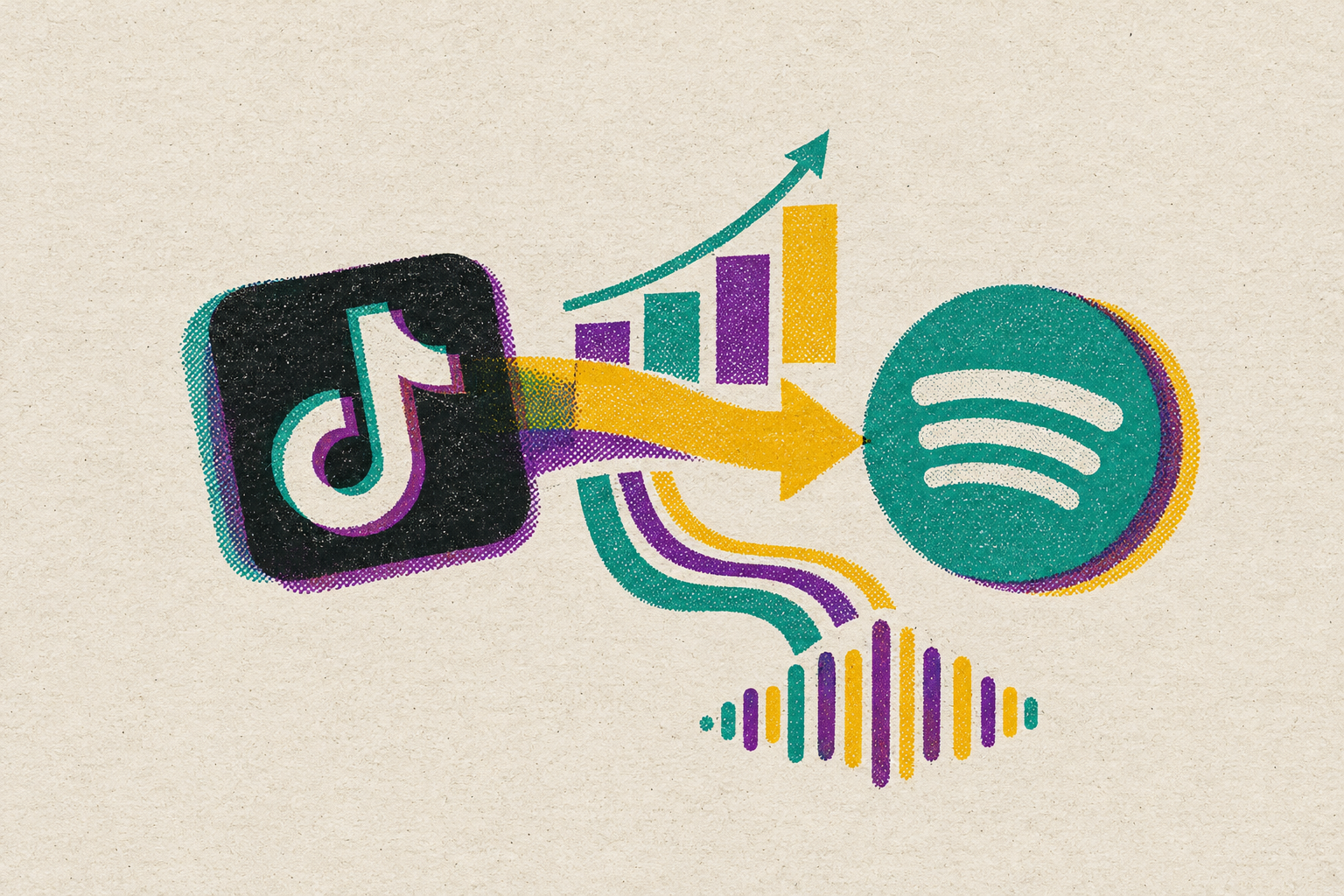
TikTok helps people find the music, but turning them into listeners takes more than TikTok alone. Spotify is where attention can develop into listening habits through algorithmic playlists, pre-saves and continued engagement with the music. Instagram gives interested listeners a closer relationship through DMs, story replies and behind-the-scenes content. Each platform serves a different listener need. A campaign confined to sound usage on TikTok leaves the subsequent relationship largely undeveloped.
To retain the traffic that seeding generates, the Spotify destination needs to match the current release. An Artist Pick pinned to that release, an updated bio and a header consistent with the TikTok visual world give arriving listeners a coherent artist profile. Instagram can then deepen the connection through reposts of fan content, behind-the-scenes clips from the same production batch and polls surfacing lyric quotes that give an already interested audience more to engage with. That audience is closer to the artist and more willing to read captions and respond.
Geese reached 1.46 million Spotify monthly listeners after their third album came out in September 2025. The network’s sound seeding contributed to that growth, while the band’s biggest track accumulated tens of millions of streams and fall tour venues were upgraded to larger spaces. Streaming growth coincided with stronger live demand. The result illustrates the potential scale of a campaign whose effects extend beyond activity on the discovery platform.
Lowen shows how the platforms can work together on a smaller scale, though her example does not show that she had the same kind of fan account network. Starting with a modest Spotify monthly listener count, she committed to daily, honest slice-of-life posting on Instagram and TikTok. Her monthly listeners more than doubled in two months. The distinction is important because the examples support different parts of the argument.
What separates fan account campaigns that converted from ones that produced noise and nothing else
Each account needs to fit the kind of content it posts. A gym-edit account can use a track because it fits workout cuts the account would plausibly post anyway. A lifestyle creator can place it in a morning routine that matches the song’s emotional register. In both cases, the content has its own purpose. That purpose gives viewers a reason to stay, so watch time and engagement show how well the posts work beyond how many get published.
Mass-produced, zero-intent filler fails at that point, including AI-generated content that looks fabricated. Low completion rates, low saves and negative engagement signals show when accounts are posting but people have little interest in what they see. Human viewers make their own judgment just as quickly. Content that reads as an advertisement can be scrolled past regardless of how many accounts publish it. A larger network does not repair the absence of a reason to watch.
Accounts working together cannot make people care enough to take part in email signups, merchandise purchases, pre-saves, tip jars or concert tickets. Without a useful place to stream the music and a reason to follow the artist, monthly listener numbers can rise and fall without building an audience that stays. The practical test for each proposed post is whether it would still make sense in its content category if the sound were removed. If it would, the sound is serving genuine content. If it would not, the post is promotion and should be judged accordingly.
Notes
- Is 2026 the fakest year in music?
Supplied the Geese example, including Chaotic Good Projects' fan, meme and sports accounts and the concerns about undisclosed promotion and AI-generated filler.