Essay Artist Case Studies
Small Label Short-Form Rollout Postmortems
A funnel-based review shows where short-form effort paid off.
A small-label short-form rollout postmortem separates the quality of the music from the quality of its distribution. Its value is not a verdict on the last release, but a repeatable playbook for the next one. Reconstructing what reached people, what prompted them to use the sound, and what brought them to streaming reveals where effort produced results and where it merely produced activity.
Why short-form campaign postmortems feel uncomfortable and why small labels avoid them
An underperforming release feels personal before it feels analytical. When streaming numbers become a proxy for artistic worth, reopening the campaign means reopening a disappointment. Moving straight to the next release is easier. This avoidance habit lets timing errors, thin content schedules, and platform misreads survive because nobody separates them from the response to the song.
That discomfort is understandable, but it obscures the review’s purpose. A postmortem examines how the music travelled. A stalled campaign can be especially instructive because an accidental hit has not hidden the gaps in its distribution. Looking back makes those gaps available for correction and helps prevent their repetition.
What a short-form rollout actually consists of, and what most small labels ship instead
A full short-form rollout takes planning, creator seeding, posts that keep coming, and a destination ready for new listeners. Content volume runs through those phases. Campaigns that work tend to make lots of short-form content for each song so they can test different hooks, formats, and song moments. One or two clips offer far less evidence. They leave the label trying to judge a song’s potential from a narrow sample of how it could reach people.
The platforms also provide different tests. TikTok introduces content to a micro-pool and expands distribution based on signals including rewatches and shares. Instagram Reels uses an interest graph and signals from what people watch and share to reach mostly non-followers. YouTube Shorts leans on completion rate, swipe-away rate, and watch duration, with topic interest playing a secondary role in personalization. These distinctions call for native-first content, rather than treating a watermarked cross-post as equivalent distribution.
Against that baseline, many small-label campaigns consist of a few promotional clips and a release-day announcement. That is a launch burst. The distinction gives the postmortem a fair reference point without turning it into a judgement about the team’s commitment. Before interpreting audience response, the review has to establish whether the campaign supplied enough content, over enough time, to test its approach.
The metrics that lie in the moment and the ones that actually tell the truth after the fact
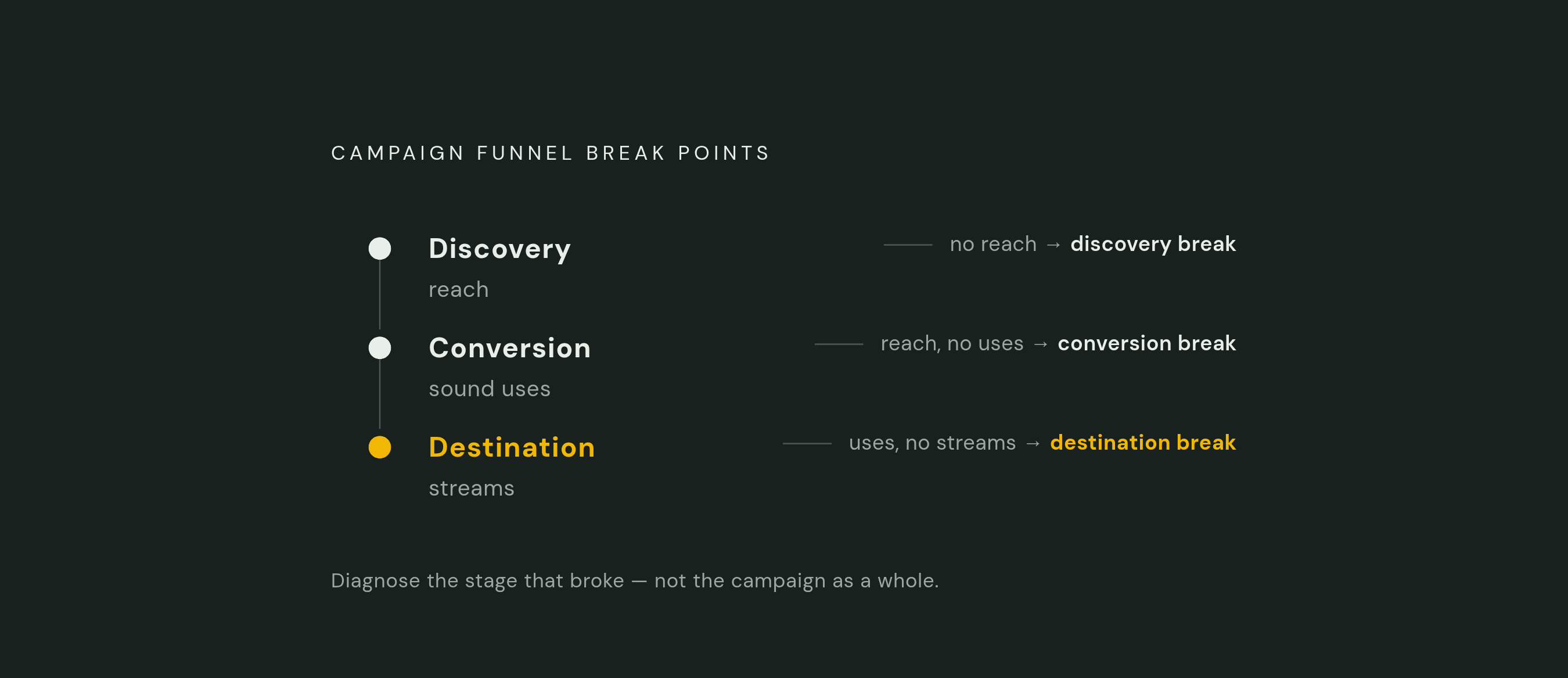
View counts, follower gains, and likes are visible during a rollout, but they are weak diagnostic tools on their own. A view establishes exposure. The campaign can be mapped as a funnel with three places where it can break: discovery, conversion, and destination. No reach indicates a discovery problem. Reach without sound uses points towards conversion, while sound uses without streams place the break further downstream.
Shares indicate discovery reach, while saves correlate with an intention to return. Their ratio helps distinguish content that people circulate from content they keep for themselves. Shares and saves should be counted separately in the engagement total. The postmortem needs to preserve the difference because circulation and return intent serve different parts of the campaign.
Growth in followers on the artist account also tells only part of the story of how the music spread. On TikTok, the more diagnostic number is how many accounts used the sound, because those uses distribute the audio beyond the original post. Playlist adds per thousand streams and growth in Spotify followers during the release window help show whether people who found the music went on to listen.
Where effort was actually wasted in a typical small-label short-form campaign
Wasted effort is work allocated away from the campaign’s actual bottleneck. It does not mean the work lacked quality. Polished production, work on press, and a launch announcement timed just right can take a lot of resources without giving short-form platforms the native content and repeated chances to spread it that they reward. Overproduced clips can also read as advertisements. An artist’s simple music-production screen recordings outperforming high-production content illustrate why production effort and distribution value are not interchangeable.
Timing creates a second mismatch. Concentrating activity in launch week substitutes a burst for consistency, while seeding creators during release week gives them little time to post organically. Seeding one to two weeks before release allows momentum to develop before the campaign moment arrives. When the timeline shows almost everything happening at once, effort may have been compressed into the wrong window.
Distribution can be too narrow as well. “New song out now” announcements and artist-brand content address the release directly, while TikTok distributes audio through content categories people already consume. Keeping every experiment on the artist account also restricts testing surface. With more than one account, including fan-style pages, the team can test different hooks and song moments without crowding the main profile. Headwired’s daily reality-show-style posts show how effort can go into keeping content coming, with less weight put on one-off announcements. Posting frequency, early engagement in the minutes after publication, and genuine content suited to the sound’s category were not the wasted work.
That discomfort is understandable, but it obscures the review’s purpose.
What actually moved streams in the campaigns that worked, and the pattern across them
Ndotz’s team identified a football edit trend and amplified “Embrace It” into it. The song became audio infrastructure for an existing category, accumulating millions of video creations at its peak and surpassing hundreds of millions of Spotify streams. The category supplied the route to discovery. Rather than asking a general audience to care about a release announcement, the campaign placed the audio inside content that audience already wanted.
The broader pattern is not confined to football edits. Morning routines, aesthetic lifestyle content, and emotional journals offer other contexts in which a sound can serve the post. Headwired’s reality-show strategy shows the value of keeping a story going, while another artist’s doubling from daily storytelling points towards a story told over time carrying more weight than a single promotional moment. These examples do not establish a universal winning format.
The campaigns that held their gains also had somewhere for attention to land. A complete profile, linked catalogue, and a fan-capture mechanism such as an email list or Discord helped prevent discovery from ending when a clip stopped circulating. Consistent Spotify presence served the listening destination. Releases every four to eight weeks then gave teams more chances to check the results and kept creator networks active between songs.
What got misread in the moment, and why the postmortem is the only place you can see it clearly
A high-view clip with no sound uses can look like the campaign’s strongest asset while it is circulating. Retrospectively, it shows a break between attention and imitation. The featured song moment may have been wrong, or the format may not have invited anyone else to use the audio. The content succeeded on its own terms. That is different from demonstrating music discovery.
The reverse is just as revealing. A modest-view clip with a high share-to-save ratio and several organic sound uses can appear unremarkable beside a larger post. In the full campaign record, it may be the format that deserved more support and immediate native cross-posting. Comparing posts by their role in the funnel reveals the difference. The smaller post may have moved people further.
Timing produces another class of misread. Silence from seeded creators can look like rejection when outreach simply happened too close to release for them to post. A Spotify increase arriving days after a TikTok post can disappear from an assessment limited to release-day performance. Reconstructing publication dates, sound uses, streams, and follower movement makes the sequence visible. That sequence helps explain what live dashboards obscured, although chronology alone should not be treated as proof that one post caused every later gain.
How to run a postmortem audit on a campaign that has already closed
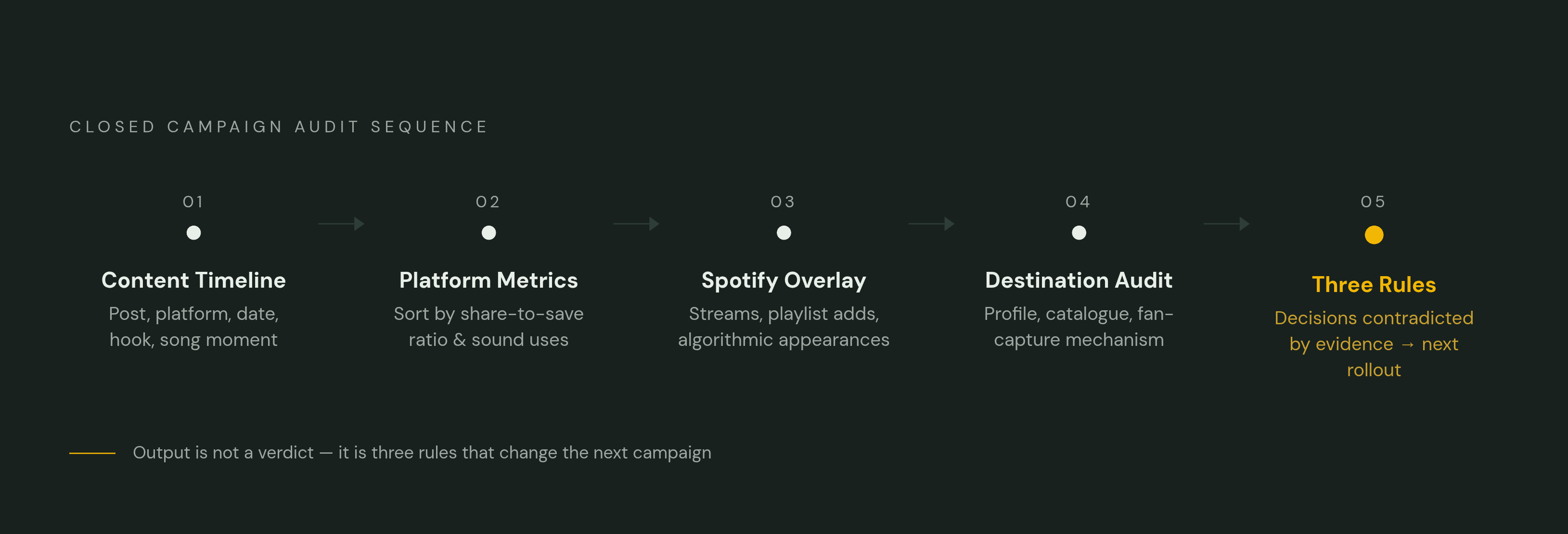
For a closed campaign, the practical task is timeline reconstruction. Basic analytics exports provide the starting material. The audit should connect content activity to platform response and then to downstream listening, preserving the dates between them. This turns a general question about success into a specific question about where movement stopped.
The first step is to reconstruct the full content timeline. It should list every post, the platform and date it was published, and the hook and song moment it used. Gaps belong in the record too. A team that remembers a busy campaign may discover that its publishing was much thinner than its workload suggested.
The second step is to pull each post’s platform metrics and sort by share-to-save ratio and sound uses. The aim is to identify which format and song moment generated imitation. The third step is to overlay the Spotify for Artists timeline, including daily streams, playlist adds, follower movement, and Discover Weekly and Release Radar appearances. The dates must remain visible. They allow the review to identify which content activity correlated with listening changes and how long those changes took to appear.
The fourth step is to audit the destination. The review should establish whether the profile was complete, the catalogue was linked, and a new listener had somewhere to land and stay. When people reach Spotify but do not become followers, discovery has taken place and the signs point to a destination problem. The fifth step is to document three campaign decisions contradicted by the retrospective evidence. Those decisions become rules for the next rollout, so the review guides choices the team can change.
Across a roster, the same audit distinguishes shared patterns from artist-specific results. The UK catalog manager case, which grew a combined listener base across eight artists by 200% over six months, illustrates the potential of consistent rollout structure at label scale. The operational value is comparison across releases.
What a smarter rollout looks like when rebuilt from the postmortem findings
The lesson for the next release is to change the allocation of effort, beginning with creator outreach. The new schedule moves outreach from release week to two to three weeks before release. Creators get a clear content-category brief in place of a request that only asks them to use the sound. This gives seeding a defined context. It also responds directly to an audit that found silence caused by late timing.
The artist account then becomes one node in a wider distribution network. Fan-style secondary accounts and creator partnerships provide more places to test and circulate the audio without making the main profile a continuous promotional feed. This adapts the multi-account structure used in major-label ecosystems to indie means.
Singles every four to eight weeks give the algorithm and creator network repeated chances to get going, and the profile is complete and the catalogue linked before attention arrives. An email list or another fan-capture mechanism gives people who find the music a way to stay beyond a platform stream. The next postmortem then checks whether those changes fixed the breaks found in the last campaign.